technique

Bringing Yourself to Art

"The Artist is Present" A viewer sitting with Marina Abramovic at MoMA - New York

Performance art is a difficult art media to understand — one which people may be less comfortable with or familiar with, than say visual art. Marina Abramovic, perhaps one of the most well-known performance artists who began her work with the emergence of the form in the 1970’s and ’80’s, is exhibiting at MoMA in a work entitled “The Artist is Present”.

In this work, she simply sits in a chair. Across from her is an empty chair in which viewers can sit for as long as they like. Some viewers sit for 5 minutes, some sit all day. A camera crew is present to photograph these viewers, many of whom are very emotional; some cry and others show extreme anguish). This is striking. What can possibly be so interesting about Marina’s face, her hair, her body, her expression?

It appears that she takes on a luminescence, that she somehow is able to look through the viewer. In interacting with others, we usually have their full attention — there is engagement. This performance art seems to keep the art on display and the viewer distanced, yet I wonder if Marina’s movements or changing facial expressions reflect the viewer’s response? After all, aren’t they also reacting to the piece and being photographed as the art? In essence, is the viewer actually part of the art? And is the title of her show “The Artist is Present” yet another clue that may allude to the viewer also being the artist?

The photos that the photographer has taken of these viewers are surely fascinating to look at, and cause me to wonder if indeed they will, in the future, be an accompanying piece to any writeup or essay on this exhibition, where the viewer is artist…

Pinault’s Emerging Artists

Sepulcher

Sepulchre

So who does Francois Pinault consider “emerging artists” such that he would include them in his collection now on view at Venice’s Biennale?  (For more on Pinault and the Biennale, see article below.) Apparently, he’s plucking artists that others (Saatchi, etc.) have already identified as gems and have given a shot at a big-time exhibition. So it sounds like he’s letting others (Saatchi) do his guesswork for him, just like how he may tap Mellon or UBS to help choose his business investments (Pinault holds the Gucci group and numerous other well-known establishments). If Pinault has similar success with picking winners in art as he has with his businesses, then roll the dice, I’m placing my bets with Pinault’s list.
So what are Pinault’s picks doing in terms of their art? What are their visions? Here’s two:
Matthew Day Jackson – in his Saatchi Gallery bio he says he’s “a sculptor who repurposes frontier symbols for political aims” — a unique concept and pretty fascinating on many levels, from the historical perspective to re-engineering “found” pieces. In Sepulchre, he took his punk t-shirts and stitched them into a mast. Is he saying that punk are the new pirates? I’m waiting for the eyepatch to come into fashion. 
Adel Abdessemed

Adel Abdessemed

Adel Abdessemed — Personally, I don’t know how he is still considered an “emerging” artist. His  CV is PHAT (10 pages!): solo and group shows all over the world, from Turin to Tenerife, and including the Pompidou and the Musee d’Art Moderne de la Ville de Paris. His works are big: at David Zwirner’s gallery in Chelsea he installed “Telle mère tel fils (which translates as “Like Mother Like Son”), which was created out of the nose and tails sections of three commuter airliners; connected by a tunnel made of white felt, the piece twists and turns like a giant serpent.” And like Matthew Jackson, he uses a lot of “found” pieces. His work has evolved from his upbringing in Algeria, but rather than focusing his art on the political climate there, he reacts to politics on a global scale.

He takes an interesting perspective on his “organic” work versus pop art:


My work is organic, constantly evolving. All of my artworks spring from an intuition of an image in construction. Things change as the work comes to life and it’s the direct experience of this construction that produces the result—as opposed to Pop Art, where the object is already finished before the work of art is created.

OK, will look at more of Pinault’s pics in the next post.


What A Novella Can Be: A Room With A View

In its review of Josh Weil’s 3 novellas (wrapped up into one volume), the NYT gets to the heart of what a novella can be:

A good novella has an intensity and concentration rarely found in novels, and an expansiveness and scope rarely found in stories. If a short story is a piece of furniture and a novel is a house, then a novella is a room — and in that room a skilled writer can sometimes find space for all the aberrations and terrors and longings of a character’s life. The right room can intimate its occupant’s past and future, frustrations and failures, the shape of the house beyond.

The room is a great metaphor for the novella. On a smaller scale than the novel, the novella is cozy. Each word must be carefully chosen — I’ve spent half an hour just crunching out one sentence — and because of this the detailing can be that much more rich and fluid.

The room analogy, however, also makes the novella seem like a subset of a novel (a room is a subset of a house), which it is not. Character development and complexity must be as fine-tuned as a novel. This may in fact make novellas trickier to write because the action and description must convey the same amount of understanding as a novel, but in the confines of a much smaller, more intimate space.

Where Art and Words Collide

Born Magazine creation

Born Magazine creation

Not to be missed. Simply NOT to be missed! Born Magazine (online mag) brings together graphic/visual artists with poets and prose writers to make magic.

http://www.bornmagazine.org/projects/chimney/

http://www.bornmagazine.org/projects/conjoined_twins/

http://www.bornmagazine.org/projects/house_fire/

The Sticker (and its message?) Sticks

EnjoyBanking's political stickers

EnjoyBanking's political stickers

When does political art become bubbly and cutesy? I guess recently in NYC… The recent economic downturn has inspired a varied group of artists (economists, photographers, filmmakers, etc.) to create EnjoyBanking, a politically charged campaign that plasters bubbly stickers all over NYC. The signs read “Enjoy Credit Crunch,” “Enjoy Bailout Package,” “Enjoy Golden Parachutes,” etc. They pack a considerable punch, delivering a pretty serious message in light undertones. Where graffiti is mostly associated with gangs and reads language in gobbledygook undecipherable by the average passersby (granted, it has been embraced as a medium in art exhibits too), the EnjoyBanking project is clear in its message. Graffiti seems more randomly placed, whereas these stickers are deliberate and targeted. The project has also been methodically engineered and rolled out:

A few weeks after their first sticker attack appeared, the masterminds behind this economically-charged street art surfaced on Twitter and Flickr to post their thoughts and images for the world to see. After a few weeks of watching to see where this project would lead, I spotted one gate impressively plastered with the bubbly words near Houston (it was part of NYSAT).

The Art of Process

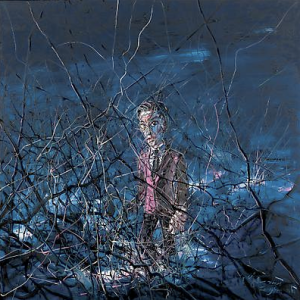
Conceiving a piece of work (a painting, a novel, a poem) can take 3 days or 3 years. Or it can happen spontaneously, as the brush hits the canvas. I’d think that more commonly artists chew on  the threads of a concept for awhile, as they brainstorm, twist, challenge, sharpen ideas that will eventually take form on paper, canvas, or in clay. This is all a part of the creative process. No less creative, however, are those whose art is conceived spontaneously, and even moreso, without the deliberate intent of the artist.

Zeng Fanzhi, "Untitled 08-12-19", 2008, Via Acquavella Galleries
 Zeng Fanzhi, “Untitled 08-12-19”, 2008, Via Acquavella Galleries

Consider Chinese contemporary artist Zeng Fanzhi‘s technique, as shown at Art Observed:

He holds two –sometimes even four- brushes at a time, allowing him to create and to destroy form simultaneously.  As a result, the paintings convey a sensation of spontaneity and sentiment.

Holding two or more brushes in hand, an artist can conceivably control only one brush; the others are simply stragglers making their own design. Looking at Fanzhi’s works, however, you can’t separate what was spontaneously created or what was conceptually premeditated, as the two techniques are seamlessly intertwined to create the “sensation of spontaneity and sentiment.” The viewer can’t distinguish between which brushstrokes were intently applied and which ones were stragglers.

In some ways,  I think this mimics daily life. With several brushes in one hand, we meticulously guide just one brush to paint our actions; the other brushes represent our scattered, non-focused, actions. Our friends (the viewers) often cannot tell what actions/comments are deliberate brushstrokes and which are not.

And so Fanzhi has captured the process of human nature: we paint our lives with many brushes.

In Art: The Constructive Process Is Where It’s At

Christopher Pekoc Gallery Image 1
Christopher Pekoc’s Night Visions 1975-2000 at the Tregoning Gallery, Cleveland

When I walked into the Tregoning Gallery on Saturday to see Christopher Pekoc’s exhibition “Night Visions: 1975-2000”, I took one look at a collage comprised of a to-scale black and white photograph cutout of the looming Cleveland Public Library’s Reading Room (see in above photo, far right) and said “Gothic.” The gallery owner looked at me pleasantly and said “Well, not Gothic.” Wince. I see a black and white photo of a big gothic-looking building and it reminded me of something out of Batman – Gotham City, Gothic City, whatever – and “Gothic” because of its ornamental detailing. I can parlay the architecture allusion into contemporary mixed media, right?

But for the next 20 minutes I switched gears to ask about the gallery building itself. The owner told its tale: built in 1905 with roots in carriage manufacturing, it’s still sprouting from the weeds of West Side Cleveland. Just the building made me want to move in and pop an artist’s lifestyle. Shiny floors, thick brick everywhere, lots of open windows, miles of track lighting… (and for real cheap too! according to a recent article in the Wall Street Journal.)

Back to the art. Pekoc’s collages were striking, yet they were all very different in composition, technique, and construction. His evolution: First Vogue magazine cut outs pasted together on canvas. Then pieces of photos arranged and shellacked, accentuated with gold leaf. Some studies with random materials sewn together, hand stitched as he turned his mother’s machine’s carriage manually, and then glued it all to handmade paper from Cambodia. Then chalk rubbed – layer upon layer, its pigment deepening — into canvas with a thumb. An enormously architectural, to-scale photograph cut out and overlaid with vivid paint (in a fusion of confusion, to me). And on and on.

Collage is my favorite media. I like it best when an artist takes trash, crumples it up, and glues it to a canvas (or a rotting piece of wood. Whatever.). First, I get riled up trying to figure out how it all came about. Then I (try to) calm down, take two steps back, and ask “What the heck was (s)he thinking?”

One other thing became evident. Going too long without submersion into a contemporary gallery renders one absolutely haywire when one gets there. And so I was all over the place. Jumping to conclusions about composition, structure, theme (as with the Gothic example, you often miss the mark!). It was hard to reign myself in as I tried to quickly reconstruct how something was made. It’s ok to take this unleashed, wild ride, but then to really figure out the piece, you’ve got to center. It’s about immersion and getting into the artist’s head. Getting there is the most challenging part. Is that the exercise that art is all about?